

Table of Content
Version 1.1.0 of Pristy Search Service, the Alfresco Search Services fork developed by Jeci, shipped in late September 2026, after several months of testing. It puts Alfresco Community’s search engine back on a standard Apache Solr 9, at a time when Alfresco has dropped all Solr support since version 26.2. It has been tested with Alfresco Community 26.2.
Since July 2026, Alfresco Community 26.2 no longer ships Apache Solr. The historical module — an Alfresco-patched Solr 6.6.5, never upgraded upstream — is replaced by Alfresco Search Community, a connector to OpenSearch or Elasticsearch distributed only as a binary, with no published source code.
Jeci has been working for several months on Pristy Search Service, a free fork of Alfresco Search Services that fills this gap: an open source Alfresco search engine, based on vanilla Apache Solr 9. It is now at version 1.1.0.
You can find the pristy-search-services repository on our GitLab.
To place Pristy Search Service within the wider Pristy offering versus Alfresco Community, see our comparison Pristy Core versus Alfresco Community 26.2.
Why this fork exists
Alfresco Community had relied for years on a Solr 6.6.5, nearly ten years old, patched internally by Alfresco and never upgraded against the versions distributed by the Apache Foundation. With all Solr support dropped in Alfresco Community 26.2, Alfresco Community deployments that want to stay on a 100% Apache base — open, up to date, and with publicly readable code — no longer have an official option.
The only alternative provided by Alfresco, Alfresco Search Community, indexes documents into an OpenSearch or Elasticsearch cluster. Those engines are themselves free software — OpenSearch under the Apache 2.0 licence, Elasticsearch more or less so depending on its successive licences. It’s the Alfresco connector feeding them that remains closed: distributed only as a binary (Docker image and compiled files), with no published source code. Hyland explains it reuses code from Alfresco Search Enterprise, its paid edition, and has to date published neither the final licence nor a date for opening the code.
Moving to OpenSearch or Elasticsearch also has an infrastructure cost: it means adding another component to install, size, back up and maintain — one more server (or cluster) for the infra team to run. For small and medium infrastructures, up to around 50 million files, Solr remains the best solution: it integrates directly into the existing Alfresco stack, with the same footprint as before. Beyond that, Jeci can set up SolrCloud, Solr’s distributed architecture, as an alternative to an OpenSearch cluster — without leaving a 100% free base.
Pristy Search Service fills this gap: it takes over Alfresco Search Services and moves it onto a Solr version actually maintained by Apache. For the end user, nothing changes in day-to-day usage: the same search APIs remain available, the Alfresco query language (AFTS) works identically, and document access permissions (ACL) continue to be enforced exactly as before — only the engine running “under the hood” is modernised.
In plain terms, for non-technical readers — Alfresco cut the only fully open search engine across the whole Alfresco Community line. The alternative provided relies on free engines, but the connector linking them to Alfresco is a black box (no source code), and it requires installing and running an extra server. Pristy Search Service avoids both problems: a 100% open search engine, with no extra infrastructure to manage.
Tech focus — a two-hop migration
Lucene only guarantees read compatibility with the immediately preceding major version. You can’t jump straight from Solr 6 to Solr 9: Pristy Search Service migrates in two steps, patched Solr 6.6.5 → vanilla Solr 8.11.4 → vanilla Solr 9.10.1 (Lucene 6 → 8 → 9, Java 11 → 17, ZooKeeper 3.4.14 → 3.6.3, Log4j 1.x → Log4j 2). Operational consequence for anyone migrating: a full re-index is required, since Lucene 9 cannot read a Lucene 6 or 8 index.
What changes compared to Alfresco Search Services
| Alfresco Search Services (historical) | Pristy Search Service 1.1.0 | |
|---|---|---|
| Solr | 6.6.5, patched by Alfresco | 9.10.1, Apache vanilla |
| Lucene | 6 | 9.12.3 |
| Java | 11 | 17 |
| ZooKeeper | 3.4.14 | 3.6.3 |
| Logging | Log4j 1.x / reload4j | Log4j 2 |
| Indexing trackers | Bundled in the Solr webapp | Standalone Spring Boot service |
The most structural change isn’t visible in the version numbers: the indexing trackers (the processes that read the Alfresco repository to feed Solr) are now a separate Spring Boot service, pristy-indexing-trackers, split from the Solr webapp. Solr and the trackers become two independently restartable and tunable services (via ALFRESCO_TRACKER_* environment variables, no image rebuild needed) — a concrete gain for production operations, especially on large document volumes.
All links between Alfresco, Solr and the trackers can be encrypted with mTLS (mutual TLS: each component authenticates to the other with a certificate), including those of the new trackers service.
Pristy Search Service also brings three new features:
- around 10% disk space saved, thanks to index compression;
- a new reranking that brings the most recent documents forward in search results;
- a new real-time indexing monitoring interface.
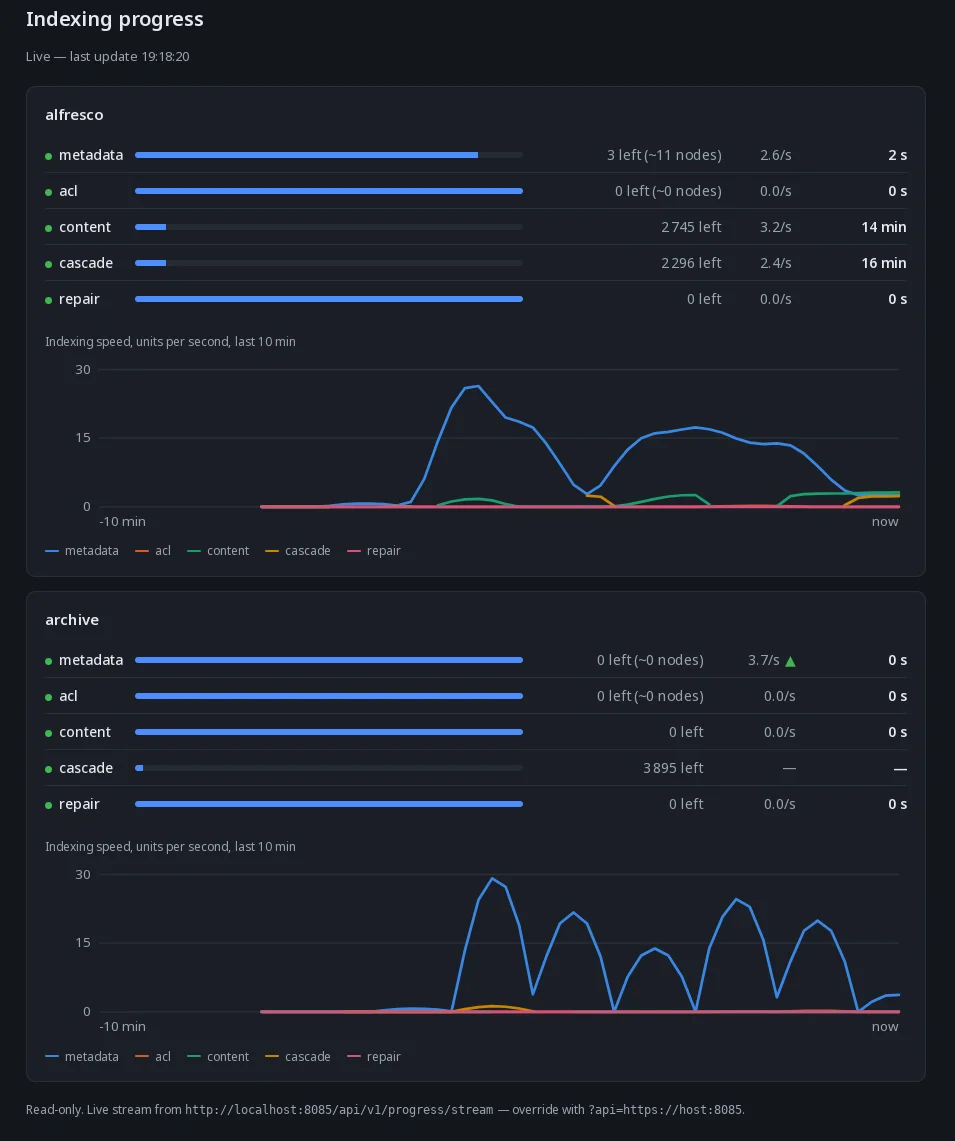
Pristy Search Service is designed and maintained for Alfresco Community: the modules reserved for Alfresco Enterprise (Insight Engine, Zeppelin, governance) have been removed.
In plain terms, for non-technical readers — The search engine goes back to being 100% standard (official Apache Solr), which makes security audits easier and removes any dependency on a proprietary component. It takes up less disk space, puts recent documents first, and indexing progress can be followed live. On the operations side, search can now be restarted and tuned independently from the rest of the system — a real gain for production availability.
Endorsed by Hyland
Hyland, Alfresco’s publisher, has featured this fork twice on its official blog, as a solution for Alfresco Community deployments that want to stay on Apache Solr:
- Bring Alfresco Search to 2026: Vanilla Solr 9, Java 17, and an invitation to the Community (by Jeci) — June 2026, with a dedicated section explaining how to try it in one command.
- The Definitive Guide to Alfresco Search Community — September 2026, which points to Jeci’s fork as a solution for deployments wanting to stay on Apache Solr.
Concretely, Alfresco’s community Docker installer now offers a “Jeci community fork” search engine option — see below for how to try it in one command.
How to try it
The fastest way is the community Alfresco Docker installer: its generator (yo alfresco-docker-installer) now offers, when asked “which search engine would you like to use?”, a “Jeci community fork (vanilla Solr 9 / Java 17, standalone trackers)” choice, for Alfresco Community 26.1 and 26.2.
npm install -g yo generator-alfresco-docker-installer
yo alfresco-docker-installer
Once you’ve made your choice, docker compose up -d starts the stack. Pristy Search Service images are published on Docker Hub: jeci/pristy-search-services for Solr and jeci/pristy-indexing-trackers for the indexing trackers. To enable mTLS encryption, choose the https mode (--solrHttpMode=https option).
For an installation from Pristy Search Service’s own source (development, contribution), the repository README details the prerequisites (Java 17, Maven 3.9+, mise) and the build process.
Licence and source code
Pristy Search Service is published under the LGPL-3.0 licence, like the original Alfresco Search Services module. The source code is publicly available on GitHub and on GitLab.
Status and availability
Pristy Search Service remains community-driven, unaffiliated with and unsupported by Hyland on Alfresco Enterprise. Version 1.1.0 marks a maturity milestone — extensive testing, load testing on large volumes, validation with Alfresco Community 26.2, official integration in the Docker installer — but like any free software project, it will keep improving with feedback from the community: usage feedback, bug reports and contributions are welcome, see the repository’s contribution guide.
Pristy, our document management suite built on Alfresco Community, benefits directly from this work — it’s the same search engine that powers it. Jeci also offers commercial support on Alfresco Community Edition, which includes Pristy Search Service, for organisations that want to adopt it with confidence.
A question or an issue with your Alfresco Community?
Our teams are here to answer your questions and help you get the most out of your DMS!FAQ
Is Pristy Search Service ready for production use?
What’s the difference with Alfresco Search Community, Hyland’s official module?
Can Solr handle very large volumes?
Does Pristy Search Service work on Alfresco Enterprise?
How do I migrate an existing index to Pristy Search Service?
Does Pristy use Pristy Search Service?
Is it free?
Can Jeci support us on our Alfresco Community?
Will Pristy Search Service be maintained long-term?
Going further
- Alfresco Community Maintenance — our Alfresco Community maintenance service.
- Pristy — our document management solution built on Alfresco Community.
- Pristy Core versus Alfresco Community 26.2 — detailed comparison.
- Pristy Search Service on pristy.fr — what search engine powers Pristy.